
Mixed-Use Development Roofing in Greenville
Mixed-Use Development Roofing in Greenville
Commercial roofing for mixed-use buildings, urban infill developments, and live-work-play properties throughout Greenville, SC.
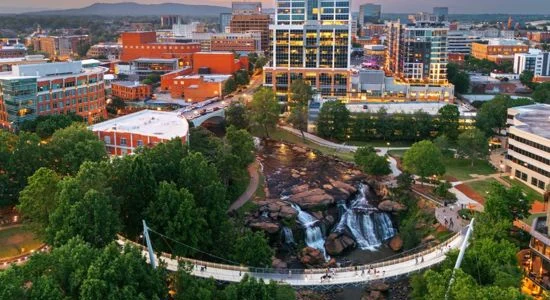
Greenville, South Carolina has earned a national reputation as one of the Southeast's most successfully revitalized mid-sized downtowns, and the mixed-use development trajectory that built that reputation is still accelerating. The Main Street corridor, the Reedy River park greenway, and the West End neighborhood have been joined by major mixed-use investment in the Unity Park area, the emerging Augusta Road corridor, and the transit-oriented development nodes anchoring the Upstate's growing healthcare and advanced manufacturing economy. Greenville's success has attracted residents from Charlotte, Atlanta, and the Northeast who bring expectations for sophisticated urban amenities - which means the apartment components of mixed-use buildings are marketed against a genuinely competitive standard that drives rooftop amenity investment and building quality.
The Blue Ridge escarpment that rises west of Greenville creates a unique weather dynamic that shapes commercial roofing performance in ways that are not obvious from regional climate data. Orographic lift from the Appalachian foothills can trigger intense, localized thunderstorms over Greenville that drop several inches of rain in under an hour - storms that produce runoff rates far higher than the regional 100-year storm data would suggest for a Piedmont location. Mixed-use buildings in the West End and along Broad Street that were designed to standard upstate South Carolina drainage criteria have experienced rooftop flooding during localized orographic storm events that exceeded design capacity. Drainage engineers working on Greenville mixed-use projects should add a local intensity factor to the regional storm data to capture this terrain-driven precipitation enhancement.
Greenville's mixed-use development in the Unity Park corridor has embraced a sustainability-forward design aesthetic that is consistent with the city's investments in green infrastructure along the Reedy River. Green roofs and rooftop terraces with living plantings are not unusual in Unity Park projects, and the Greenville County stormwater management program provides credit for vegetated roof systems that reduce runoff. The Piedmont Upstate climate - more rainfall than coastal South Carolina, moderate temperatures, and adequate humidity to support established plantings - is well-suited for extensive green roof systems using native Appalachian foothills species. Sedums, native ferns for shaded sections near parapet walls, and native wildflower mixes have performed well in the Greenville climate when planted in growing medium depths of three to four inches.
The mixed-use projects along Greenville's Main Street corridor include buildings that are among the most scrutinized in the city, both architecturally and from a preservation standpoint. The Main Street Historic District overlay imposes aesthetic constraints on parapet profiles, coping materials, and visible roofline elements that require Historic Preservation Commission coordination before any reroofing or addition project proceeds. Several Main Street mixed-use building owners have been surprised to discover that replacing deteriorated aluminum coping with a different metal profile - even with matching dimensions - triggered a HPC review process that added months to the project timeline. Engaging preservation consultants early and specifically asking whether the proposed roofing material changes qualify as "in-kind replacement" or "alteration" under the local standards avoids these delays.
The automotive-adjacent manufacturing economy around Greenville - with BMW's Spartanburg plant drawing a broad Tier 1 and Tier 2 supplier base to the Upstate - has created a significant industrial and light-manufacturing tenant demand in Greenville's mixed-use buildings, particularly in the Innovation District and the West End's maker-focused projects. Manufacturing tenants have exhaust and ventilation requirements that create complex penetration schedules on mixed-use roofs. Custom exhaust systems for metalworking, finishing, or electronic assembly operations need to be coordinated with the roofing contractor before installation, with proper flashing details that address both the penetration geometry and the thermal and chemical characteristics of the exhaust stream. Roofing system warranties on mixed-use buildings with manufacturing tenants should be reviewed carefully for exhaust-related exclusions.
Reroofing occupied mixed-use buildings in Greenville's Main Street corridor requires a coordination framework that accounts for the economic importance of the street-level experience. Greenville's nationally recognized Main Street retail and dining environment is an asset that depends on uninterrupted pedestrian access and a quality public realm. Construction barriers, material storage on sidewalks, and overhead hazard exclusions must be managed with the same care that the city applies to its streetscape improvements. A dedicated construction coordinator who maintains daily communication with the Downtown Greenville Association and individual tenant managers throughout the reroofing project is not an overhead luxury on a Main Street project - it is an operational requirement that the building owner should budget as a project cost.
Fire-rated roof assemblies in Greenville's mixed-use buildings must be designed for the specific occupancy separations in each project. Buildings where restaurant or bar occupancy occupies the ground floor beneath residential - a common configuration in the West End and Reedy River area - face additional fire code scrutiny because of the Class A fire hazard associated with commercial kitchen operations. The roof-ceiling assembly above a commercial kitchen must be designed as a fire-resistive system that accounts for potential grease fire scenarios, which means non-combustible insulation, fire-rated penetration assemblies at all duct penetrations, and coordination with the mechanical engineer on kitchen exhaust duct clearance requirements. South Carolina's building code adoption includes specific amendments that should be reviewed with a local code consultant before assembly selection.
Greenville's competitive apartment market - driven by proximity to Furman University, Bob Jones University, and the growing healthcare employment base at Prisma Health and Bon Secours - creates genuine rooftop amenity demand in mixed-use buildings targeting professional renters. Rooftop amenity decks in Greenville face a climate that includes both summer heat and humidity and occasional winter ice events in the higher elevations above 1,000 feet. Paver pedestal systems should use adjustable-height pedestals with freeze-resistant base materials, and drainage should be designed for both the intense local storm events driven by orographic lift and the sustained winter precipitation that occasionally arrives as freezing rain. Post-winter inspections in March that document paver movement and pedestal condition before peak spring occupancy of the amenity deck are essential.
Preventive maintenance for Greenville's mixed-use roof portfolio should be centered on the city's seasonal weather patterns. Post-summer inspections in September, after the peak of Greenville's thunderstorm season, document any membrane damage from the season's intense local storms and address it before winter. Pre-spring inspections in February ensure that any winter ice damage at parapet caps and flashings is repaired before the spring rainy season. Buildings with commercial kitchen tenants should add semi-annual inspections of rooftop grease exhaust systems and adjacent membrane sections to maintain warranty compliance and manage the chemical degradation risk that grease exhaust creates at single-ply membranes.
Request Roof Walk